
Introduction
Are you looking for the best home subwoofer that will give you value back for your money? We have done a comprehensive research and written a detailed review of the 3 best home subwoofers under $300 to help you make an informed decision you will not live to regret.
Ours is a thoroughly researched review to narrow down to the top three subwoofers, backed up with honest Amazon top ratings and honest customer reviews. We bring you what people are actually buying for use at home considering different factors and the needs of the users. We have dug deep in the manufacturers’ website to write your information, you never knew about these products.
To get started, we introduce to you the best and high-quality subwoofers in the market today. The models we reveal here are the top-rated and gives the best quality sound while lasting longer, making them a darling to many.
Brands
Top 3 Best Home Subwoofers
This review will guide you through choosing the best home subwoofer, depending on the kind of specifications you are looking for. All the three subwoofers we are discussing here are rated high, described as next to perfect and will give you value back for money spent. Make a good choice based on our review to get the subwoofer you so much need.
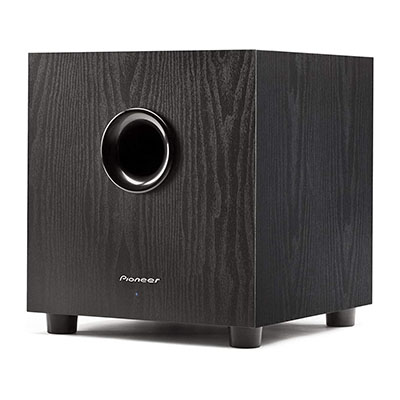
Pioneer SW-8MK2 100W Powered Subwoofer for Home Theater Review

The new model Pioneer SW-8MK2 100W Powered Subwoofer is the right choice for you.
The subwoofer looks small but is loaded with power. It is ideal for use as a TV speaker or your living room centerpiece. It is a sophisticated and compact look. It comes packed with great features, perfect design and is quite compact, will fit almost in any small room Improve your movie and music experience by installing these pieces.
The features include a sleek design, compact, impressive sound, and a customizable sound. You get all this at a very affordable price.
Features
- Sleek and Stylish: The Pioneers SW-8MK2 is a great subwoofer that is built with beauty in mind. It fits well with almost every type of house décor. A modern lavish and elegant look. It feels sophisticated and stylish and outstanding in your living room. When switched on, they have a blue light and a compact look that makes them glow amazingly. Considering the quality, and high-class design, this subwoofer perfectly matches the price.
- Impressive Sound: This subwoofer brings a different high-level of sound quality, instantly change the quality of your music and movies 1000 times. The music is enhanced and the quality is enjoyable. The sound makes movies come to life, taking the experience to a whole new level. The sound quality is not interfered with, even if you combined it with your high-def Blu. Crank the volume to maximum and it only grows stronger, no distortion. This is a good replacement for your old subwoofer.
- Customizable Sound: Pioneers SW-8MK2 comes with an inbuilt sound customizer. The subwoofer comes with a crossover and phase adjustment to allow the user to make changes to sound quality, allowing fine-tuning depending on the size of your room. You can adjust the speaker to get the best optimal sound in a small or large room. The highs and lows are definitely recommendable.
- Quality Build: Pioneer SW-8MK2 is a great build from wood grain and features removable grills. The removable parts allow for ease in cleaning and maintenance of the sound system when necessary.
- Vented Closure: The enclosure or cabinet design is vented specifically to allow for more room to create extended bass. The enclosure is also designed intact to get rid of any vibration or unwanted sounds.
Specifications
- The power rating of Watt - Frequency response of 38 Hz to 150 Hz
- Weighs 20 lbs. or 9.07 kg
- An 8-inch long-throw woofer driver - Phase adjustment
- Crossover adjustment - Line level and speaker level inputs
- The dimensions in inches (H 14,3/16 x W 13, 3/16 x D 12, 3/16)
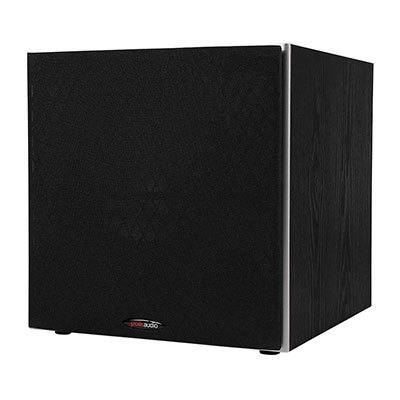
Polk Audio PSW10 10" Powered Subwoofer Review

The Polk Audio PSW10 10-Inch Powered Subwoofer is ideals for those looking forward to reducing their sound system high and mid frequencies. It is average in size, at only 10 inches, slightly larger than Pioneers SW-8MK2. It was built with the right material, geometry, and time was taken to construct this sturdy item. Polk Audio PSW10 has an impressive deep bass capability. This is a perfect choice for bass enthusiasts. The main features in this model include a dynamic balance woofer, an intelligent amplifier, and a non-resonant compact cabinet.
Features
- Dynamic Balance Woofer: Polk Audio PSW10 is built with a dynamic balance woofer, this is a feature that makes you enjoy the system bass, making it ideal for yielding high-quality movie and music sound. The system is designed to produce a deep, pounding sound. It gives a perfect speed, sound, and fine mix quality.
- Intelligent Amplifier: When setting to low volumes or when in a standby mode, Polk Audio PSW10 saves you energy by consuming a very low amount of power, unlike other systems. If you have a problem with your current sound system giving you a higher-end month bill, then this is the perfect choice for you. This is categorized as a green technology
- Non-Resonant Compact Cabinet: The cabinet was brought into the design to give maximum impact. It is sizeable, not consuming a lot of your space while doing its best to give you maximum bass.
- Quality Material: Every material that went into building the Polk Audio is a high-quality selection. This means that the design handles power well, consumes less energy while giving bigger deeper bass. It outdoes the competition through Balance driver materials.
- Passed Recommended Tests: All products by Polk are taken under rigorous and thorough industry-recommended quality tests. Specifically, Polk Audio PSW10 has undergone and successfully passed salt and UV exposure test, extreme signal response and drop testing.
Specifications
- Total frequency response between 35 Hz to 200 Hz
- Upper 3dB limit of 160 Hz kHz and a lower limit of 40 Hz Speaker level output
- Line level and speaker level inputs
- 220v amplifier, a bandwidth of 40 to 200 Hz
- 50 Watts continuous power
- 100 Watts Dynamic power
- Dimensions in inches (H 14, 3/8 x W 14 x D 16, 1/8)
- Weighs 26 pounds or 11.8 kg
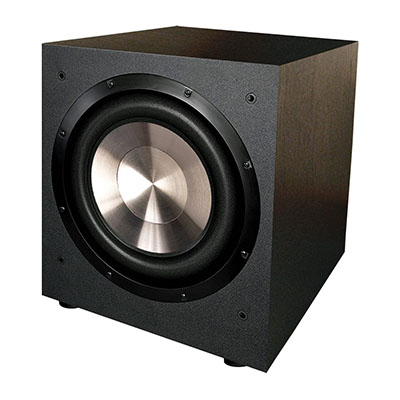
BIC America F12 12-Inch 475-Watt Front Firing Powered Subwoofer Review

The BIC America F12 12-Inch 475-Watt Front Firing Powered Subwoofer designed by BASH Technology, integrating into the model a long-throw woofer. The model features a high-level input, adjustable volume control, automatic single sensing, adjustable crossover and both Dolby Digital/DTS inputs and Dolby Pro Logic.
It is highly powered at 475 genuine watts. The subwoofer works perfectly with your existing sound system to efficiently amplify the bass sound. This model is big, but the sound is the perfect, high-quality material design and perfectly priced for its value. It has an amplifier power, a venture vent, and 150-watt power.
Features
- Venture Vent: The BIC is the only device with a built-in Venturi, which is a patented product. Venturi vent gets rid of port noise. When air passes through your ports, you are most likely to hear a “chuffing or squawking” sound; venture is designed to get rid of this kind of noise generated by the ports when playing music or audio.
- Amplifier Power (Built-In): The BIC America comes with 475 Watts Dynamic Peak and an additional 150 Watts RMS for the purpose of amplification. The frequency rates range between 25Hz to 200 Hz together with a sensitivity of 90dB. The amplifier’s ability makes your sound clear and more purified.
- Magnetic Shield: The model has an inbuilt dynamic shield that helps to get rid of distortions when you place your subwoofer close to your laptop or TV. The shield is automatic.
Specifications
- Dimensions in inches are 17 x 14.8 x 17
- Weighs 39.6 pounds or 18 kg
- 90 dB sensitivity
- 150 Watts continuous RMS and 475 Watt dynamic
- Gold plated terminals
- Frequency terminals of between 25 to 200 Hz
- Front-firing design, 12 inches
- 8 Ohms impendence
Buying Guide - What You Should Look For in a Subwoofer
The first thing to consider when looking forward to buying a subwoofer is the power you need it to yield. If you have a much bigger room or are looking for a room-shaking bass, then you need to consider a sub built with a bigger amp. Generally, the bigger the driver, the louder the bass, go for bigger chassis 10” or 12” subwoofers. Here is what you need to look for before buying a subwoofer:
- Size and Power: if yours is a very big room or you crave a room-shaking bass, then amp-built in subwoofers are the best for you.
- Placement: the low-end frequency sound waves are normally omnidirectional, subwoofer placements, therefore give you more flexibility.
- The type of enclosure: the other name for subwoofer cabinets are enclosures, they house your system. The performance and output of your subwoofer system will depend on the design. Acoustic and bass reflex are the two common types. Acoustic suspensions are built with a sealed box to give a huge bass response. Acoustic gives accurate and tight bass but will consume more power than reflex design. Bass reflex adds a “tuned” port to your system.
- Control system: you want your subwoofer easy to use. Look for a remote control digital control systems. It is inconvenient having to walk across the room when your phone rings.
- Wireless code systems and preset modes: today people want less wire running across the floor. The customization and enhancements are also essential, but this depends on what you are listening to, video games, movie, rock jazz, night-time listening, etc.
Conclusion
It’s a pleasure reading through our long subwoofer review. We gave a detailed description, of the products, their features, pros, cons and the verdict on each. Hopefully, this gave you hint at the kind of subwoofer you should buy.
Based on the above review, we determined that the three subwoofers are best in their own functions, and are cheap subwoofers. BIC America and Polk Audio subwoofers are 12 and 10” respectively, the larger the cabinet the louder the sound. They, however, occupy more space. Pioneers SW-8MK2, on the other hand, is compact, 8” subwoofer suitable for small to medium room consuming low power. All the three are powered subwoofers, giving you maximum quality and value back for money. Depending on your personal needs, you can choose which one bests suits you. You are sure not to go wrong about any of these three since they are the best home subwoofer.
Last Updated: 21st Jan, 2025

Oğuz Tokatlı
Co-Founder, Editor, Content Creator, and Full Stack Web Developer of ReviewsByPeople.com. I am here to provide you the best content.
Comments
Leave the first comment