What are the types of sheds?
Storage sheds come in various materials, designs, and sizes. The main types of shed materials are:
Wood sheds: If you want to make your own shed from scratch, you will probably be building a wood shed. This material is the most common type of shed. It has good strength and a great appearance that fits with the trees and bushes in your backyard. But the cost of building your own shed can be pricey, and wood materials are prone to peeling, rot and decay over time.
Metal sheds: The metal material provides the strongest and most durable type of shed. If you are using a shed to store heavy duty items, then a metal shed is the right fit. But the design of a metal shed often makes it look dull, and the cost of metal sheds can be quite expensive.
Plastic/resin sheds: If you want a good shed for the money, a plastic or resin shed may be what you need. These plastic resin sheds are not as durable as wood or metal although certain brands have proven to withstand storms with high-speed winds. Since these sheds are made from plastic, they often have more affordable prices compared to wood or metal sheds. The designs look good, and you can find many pre-built kits that are ready for you to assemble in your backyard.
Regardless of the type of shed you choose, you ought to build a foundation for the shed. It’s possible to build a shed on level ground alone, but a wood foundation or concrete slab gives extra strength and stability. With a strong foundation, you can enjoy your shed for many years to come.
What are the best storage sheds to buy?
Living in a clean, neat and comfortable home is the dream of many families. As your family grows with the addition of new members, it makes sense that the amount of your belongings also grow. After some time, it feels that all these belongings need their own space inside or outside your home.
In a scenario like that, an outdoor storage shed could be the right solution for your needs. A storage shed building can give you plenty of extra space to store various belongings of various sizes. Some benefits of having a storage shed in your backyard are:
- You can free up space in your garage while you renovate the garage
- You can keep your gardening tools and equipment safe from harsh weather
- You can store seasonal items (such as pool equipment) during when you don’t use them
- You can even use the shed as a workshop or chicken coop if it is large enough
Those are just some ideas on how you can use an outdoor storage shed. If you have a shed that is big enough, you can use it to store lawn mowers, snow blowers or generators. I’ve seen one person who uses his shed for storing a telescope in a makeshift observatory. You can get creative with how you use your shed, but the question that is on your mind right now is what is the best outdoor storage shed?
Best rated sheds – review of brands and price comparison
There are many brands that offer their models of the three types of sheds above. If you’re wondering who makes the best wood, metal, or plastic storage sheds, then take a look at our brand and price reviews below.
Here are our top picks for best sheds according to several criteria:
| Pick | Best For | Standout Feature | Check Price |
|---|---|---|---|
| Lifetime Dual Entry Shed | Best Overall | Steel-reinforced HDPE panels with doors on two sides | Check Price |
| Suncast Tremont | Fastest to Assemble | Resin build, ready in 3-4 hours, rated for 65 mph winds | Check Price |
| Keter Newton | Best Looking | Wood-plastic composite look with a 10-year warranty | Check Price |
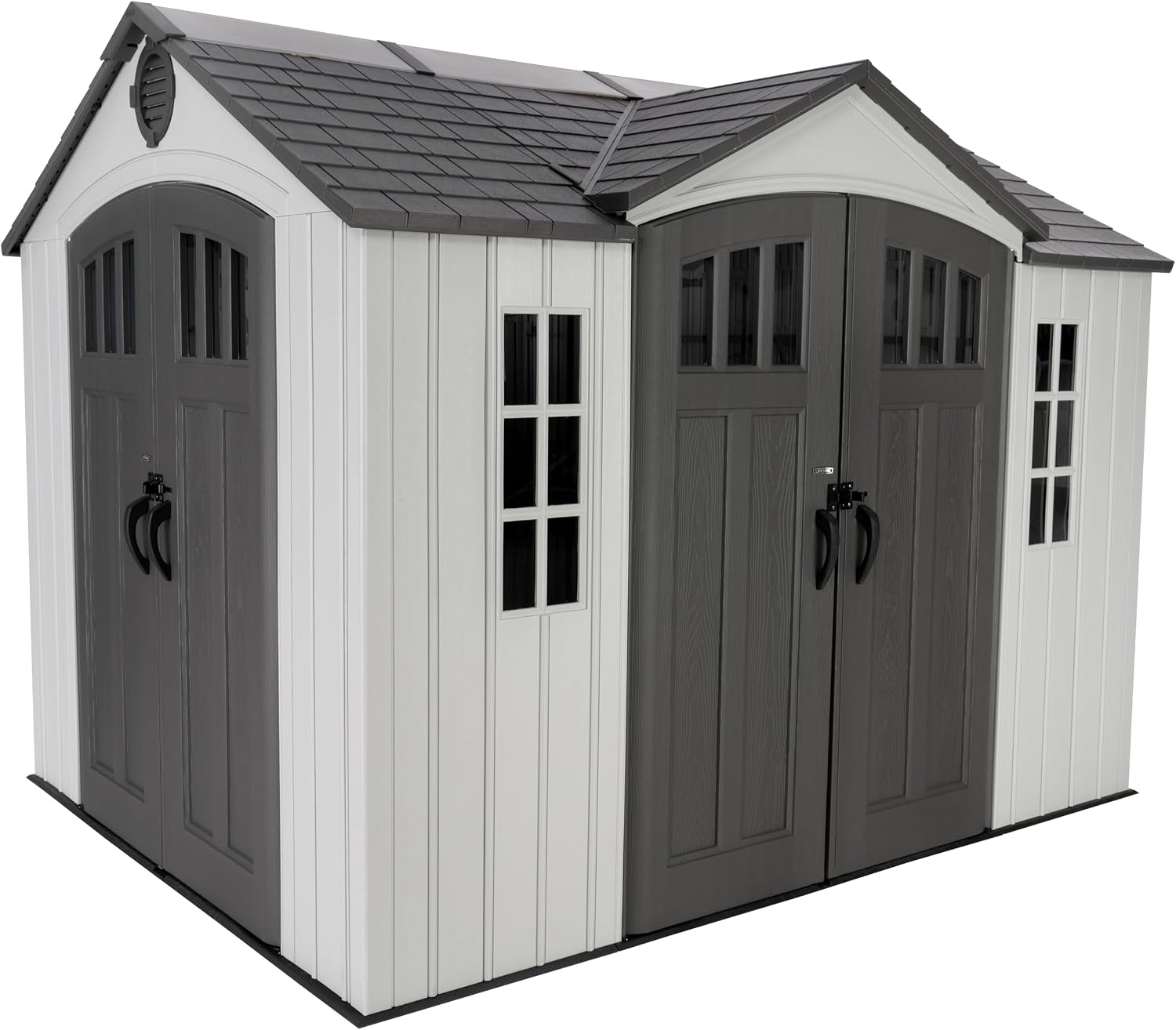
Best overall shed – Lifetime 10' x 8' Dual Entry Storage Shed Review

Lifetime has quietly become the brand people compare everything else to, and the 10' x 8' Dual Entry Storage Shed is a good example of why. It's built from dual-wall, steel-reinforced HDPE panels that lock into a full steel truss frame, so the walls don't flex the way thinner single-wall resin sheds do. You get roughly 80 sq. ft. of floor space and around 490 cubic feet inside – enough for a riding mower, a full wall of garden tools, and a couple of bikes with room to spare.
The headline feature is right in the name: doors on two sides. That sounds like a small thing until you're trying to wheel a mower out one end while the lawn tools are stacked by the other door. Four skylight panels keep the inside bright without wiring in a light, and the fold-in-half shelves and floor panels make the whole kit easier to carry into the backyard than a shed this size has any right to be.
How long does it take to assemble the Lifetime Dual Entry Shed?
Budget a full day for this one. Reviewers consistently land in the 6-8 hour range with two people working together, and Lifetime's own instructions assume the same. It's not a technically hard build, but there are a lot of panels to track, and skipping ahead tends to cost you more time later than it saves. A cordless drill is basically mandatory, and you'll want a mostly-flat, cool day to work in since the resin gets slippery to handle once it warms up.
- Start with a level foundation – a compacted gravel pad or concrete slab works best
- Assemble the floor panels and steel floor frame first
- Stand and connect the steel wall trusses before sliding in the HDPE wall panels
- Install both door assemblies and the skylight panels
- Attach the roof trusses, then the roof panels working from one end to the other
- Fit the vents, shelving, and hardware last
A perfectly level base matters more here than with most sheds – several owners note that a foundation that's off by even half an inch makes the doors bind. If you're not confident pouring a slab yourself, a paver base or a pressure-treated wood frame filled with gravel is a common workaround.
One thing to plan for: this is a premium-priced shed compared to the entry-level plastic options, and the price reflects the steel-reinforced build. If your budget is tight, it's worth cross-shopping before you commit.
What are the customer reviews of the Lifetime Dual Entry Shed?
This shed tends to earn some of the highest marks in its category, with most of the pushback aimed at the assembly time rather than the finished product.
Pros:
- Owners describe the panels as noticeably thicker and stiffer than competing resin sheds, with a convincing wood-grain texture
- Multiple reviewers report the shed kept everything bone dry through heavy rain and storms
- The dual-door layout gets singled out repeatedly as genuinely useful, not just a gimmick
- No painting or sealing required, and the resin hasn't shown fading after a season in direct sun
Cons:
- Assembly is a full day commitment and really needs two people
- The instruction manual's diagrams are on the small side, which slows down first-time builders
- Costs noticeably more than basic single-wall sheds
- Because the doors are on opposite sides, the shed needs a bit more clearance around it than a single-entry design
Long-term durability reports are still catching up given how recently this model launched, but early owners and the steel-reinforced build give it one of the stronger reputations among resin sheds sold right now.
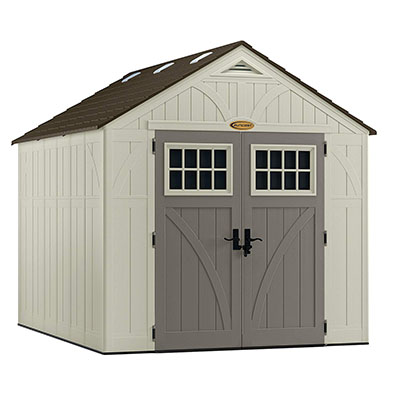
Fastest shed to assemble – Suncast 8' x 10' Tremont Storage Shed Review

Suncast is still one of the most popular shed brands out there, and the Tremont remains one of their best-looking models years after its release. It's still holding up well against newer competition, and it's one of the quicker resin sheds to put together – reviewers regularly report having it standing in around three to four hours. The 8' x 10' footprint gives you roughly 547 cu. ft. of storage, which is enough for a riding mower plus the usual garden gear. It's also rated to handle winds up to 65 mph once properly anchored.
The windows are the one part that tests people's patience. They look great once in, but a fair number of buyers say the panel fit is fussy and takes longer than the rest of the shed combined.
How long does it take to assemble the Suncast Tremont?
Suncast recommends two people and budgets around 3-4 hours, not counting the foundation. As with any resin shed, don't skip the foundation step – a wood frame filled with gravel or a poured concrete pad both work. One popular trick from owners is a metal base topped with treated plywood.
- Build the wood or concrete foundation first
- Pre-assemble the door, side panels, and front/rear headers
- Install the left front panel, then work clockwise around the side panels
- Install the double doors
- Add the front header above the doors, then the rear header
- Assemble and attach the roof reinforcement structure
- Install the roof panels
Laying out every part before you start pays off here – the pre-assembly stage is what makes the rest go quickly. Plenty of people have built this one solo, but a second set of hands makes the panel-lifting steps much easier.
Worth knowing about the windows: they're fixed – they don't open, and visibility through them is limited unless you're standing close. Some owners swap the tinted panels for fine mesh screening to get more light and airflow.
What are the customer reviews of the Suncast Tremont Shed?
The Tremont still pulls strong ratings. Assembly quirks aside, most owners end up happy with a good-looking, sturdy shed.
Pros:
- Several buyers report finishing assembly in about three hours after pre-sorting the parts
- One long-time owner says it shrugged off one of the roughest winters they'd had
- Others report it holding up through 65 mph winds and extreme heat without warping
- Enough room reported for a riding mower, two push mowers, a mini-tiller, and still space to move around
Cons:
- A slower minority of builders report taking two to three days total
- Some worry the floor feels thin under heavy tools and equipment
- A few owners of several years report minor cracking after prolonged heat exposure
- The window panels are the most commonly cited headache – some buyers reach for super glue or a hot glue gun to seat them properly
Missing hardware on delivery does come up occasionally, but Suncast's customer service is generally quick about sending replacement parts.
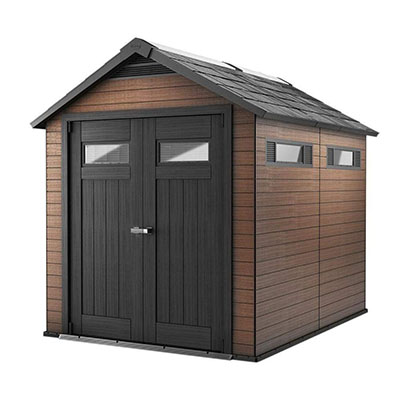
Best looking shed – Keter Newton

If looks matter to you as much as function, the Keter Newton is still the one to beat. It's built from wood-plastic composite (WPC), which gives it a genuine wood-grain texture without the upkeep – no staining, no rot, no splinters. It's not the largest shed in this lineup, but the tall ceiling makes it feel roomier than the footprint suggests.
The main complaint that comes up is a plasticky smell out of the box. It's typical of composite resin products and tends to fade within a few weeks of airing the shed out, but it's worth knowing about going in.
The features of the Keter Newton shed are:
- Thick double-wall wood-plastic composite structure
- Walls you can actually drill into for mounting extra storage
- Tall ceiling that lets adults move around without stooping
- Steel-reinforced roof rated for heavy snow load
- Full-length skylight for natural daylight
- Four windows – two per side – plus ventilation
- Pre-cut tongue-and-groove panels for a more straightforward build
There's a built-in padlock hasp, so it locks up like a proper outbuilding rather than a flimsy plastic box. Between the ventilation and the skylight, it doesn't turn into a dark, stuffy box on hot days the way some cheaper sheds do, and the 10-year warranty is reassuring for a purchase this size.
How to assemble the Keter Newton shed?
Keter's own guidance is two people and roughly 5-6 hours. The wall assembly sequence is a little different from most sheds on this list, so it's worth reading through the full manual before starting rather than assembling as you go.
- Assemble the floor panels
- Install the corner frames
- Begin with the right front wall panel
- Build the remaining walls counter-clockwise, bottom to top
- Install the front door frame and double doors
- Fit the front gable, then the rear gable
- Assemble the roof reinforcement and set it on top of the walls
- Install the roof panels over the reinforcement
- Finish with the door handle and padlock hasp
A level base is just as important here as with any resin shed. Keter publishes an official walkthrough video showing a two-person team assembling this exact shed if you want to see the sequence in action before you buy.
What do the customer reviews say about the Keter Newton?
Reviews remain mostly favorable, with a handful of recurring minor complaints.
Pros:
- One buyer put it together in about five hours with a friend
- A 6'2" owner confirms the ceiling height is enough to stretch upward comfortably
- A Southern California owner reports it held up through a very heavy downpour without leaking
- Owners fit a surprising amount inside – snow blower, mower, patio furniture, a cooler, a wheelbarrow, with room left over
Cons:
- Even with ventilation, the new-composite smell is a common early complaint
- Some builders report the assembly stretching close to a full day, and recommend two people minimum
- The floor, skylight, and door hardware feel like the weakest-quality parts
- Shipping delays of two weeks or more come up periodically, and damaged-in-transit units have needed replacement parts
When is the right time to buy a shed?
The sheds above are our top picks to show you the best brands and models on the market. If you want to save money, the best time and place to buy a shed is during a discount or sale at a store. You can buy from a local store near you or from an online store. Both local and online stores often offer fast delivery to your home. But the benefit of purchasing from an online store is that you can browse many brands and models and read positive and negative customer reviews without leaving the comfort of home.
Filling out the rest of the yard? Our best cordless hedge trimmers guide and best backyard playsets guide cover two more common backyard purchases.
Published: 5th Feb, 2025 · Last Updated: 31st Aug, 2026
We re-check the picks in this guide periodically and update it when models are discontinued or better options appear.

Tumay Kilinc
Tumay co-founded ReviewsByPeople.com in 2018 and focuses on turning long, confusing buying decisions into straightforward recommendations across electronics, outdoor gear, pets, beauty, clothing, and home & garden. Reviews are built by comparing real specs and verified buyer feedback rather than repeating marketing copy, and reader questions in the comments get read and answered directly.
Comments
Bob Martin6 years ago
I bought a Rubbermaid shed in 2006 after Katrina, it is still holding up well, 13 years. We have a LOT of squirrels here so don't even think about wood, and metal rusts pretty fast in our climate. It has warped a little but not enough that it can't be used. I now have downsized to 960sq ft but the house has a really cute cottage type wood storage shed. It had lots of rot, bugs and yes the squirrels have been successful in knawing holes in it. Going to tear it down and get another Rubbermaid.