
What is a Food Dehydrator?
A food dehydrator is a machine used to remove moisture from food to assist in its preservation. The dehydrator utilizes heat and generates air flow to lower moisture content of food before preservation. Many foods especially vegetables and fruits have between 80% and 95% water content. By lowering the moisture content using a food dehydrator, you are sure of restraining different types of bacteria, fungi, and molds from spoiling the food and lengthening its shelf-life.
The dehydrator consists of four main parts that help in drying food; heating elements, air vents, fans, and food trays. The heating element warms your food stacked in trays making it release moisture while the fan blows the moist air out through the vents. The process goes on for hours until the moisture content is lowered to about 20%. At this point, many foods can stay for many months without getting spoilt. For nuts and cereals, the enzymes remain inactive but alive.
Dehydrators dry food at 54 °C(129 F) even though making jerky requires heating meat at higher temperatures of 68 °C(154 F). The success of any dehydration process is in the application of steady temperatures and good air circulation. If the temperatures are too high, the results will be hardening of food on the outer parts but moist. This makes it vulnerable to getting damaged on the inner part.
Types of Food Dehydrator
Here are two main types of food dehydrators; the vertical flow food dehydrator and the horizontal flow model. Though both are used with good results, each comes with a number of pros and cons that a buyer should understand before making a decision on which to buy.
The Vertical Air Flow Dehydrator
This machine is designed with an up-and-down orientation to facilitate vertical movement of hot air. The heated base and fans are located either at the lower or upper part of the machine so that hot air is pushed up and escapes through the vents. The model with a dehydrator at the bottom provides better air flow because hot air easily moves up. Unlike the model with top positioned fan, the type of a fan at the top has to work harder to force hot air move downwards and force it to escape via vents fitted on the lower section.
When the fan and heater are located at the bottom, drying juicy items like tomatoes may result to the sap dripping down and damaging the machine. Because of poor air circulation associated with vertical airflow dehydrators, you can only get perfect results when you rotate the trays manually during the drying process. If you fail to rotate the trays, food closer to the heating element will dry faster compared to others in the dehydrator. This makes it unsuitable for people with busy schedules because one is required to keep checking for some time until the process is complete.
Pros of vertical flow dehydrators:
- The machines are more affordable compared to the horizontal types
- Vertical airflow produces better results when the type of food being dried is fish, raisins, herbs, or strawberries.
- This dehydrator is ideal for small household units that do not require drying a lot of food.
- Provided that the owner does not forget to rotate the trays in the drying chamber (they are therefore perfect when working at home or cooking in the kitchen because one is available).
Cons of using vertical flow dehydrators:
- Heat distribution in this dehydrator is uneven (heated air tends to follow a specific pattern that can leave some foods only partially dry).
- Because of poor heat distribution, it is difficult to dry some food types such as bananas, meat, and chicken.
- The dehydrator requires full-time attendance to rotate the trays. This makes it not ideal for people with busy schedules or requiring multitasking.
- When heating element and fan are located at the bottom, they can easily be damaged by sap that drops from some foods like meat.
Horizontal Air Flow Dehydrator
This type of dehydrator is available on stackable designs and horizontal types. The dehydrators are more expensive compared to the vertical types. Heating occurs across every tray that makes it even and, therefore, perfect for heating the even meat and tough fruits. The heating element and fan are located on the side to help drive hot air evenly.
Unlike the vertical model, tie type of machine is better or busier households since food can be placed on trays and allowed to dry without turning the trays. Many people leave the machine on at night when they are asleep or concentrating on other duties. Simply set the moisture content level you prefer and leave the machine to do the job.
Pros of horizontal flow dehydrator:
- The machine achieves even heat distribution and drying on food stored in every tray.
- Because there is even heat distribution, this type of machine is ideal for drying tough fruits and even jerky.
- The dehydrator is also good for heavy duty drying such as when one is having an event, preparing winter food, and even commercial stores because of even heat distribution.
- Since trays do not require being rotated manually, the horizontal machine is ideal for people who have very busy schedules or simply want concentration on specific tasks as food dries.
- Food dries faster and the machine is therefore ideal for people who enjoy trying varying recipes.
Cons of horizontal flow dehydrator:
- Horizontal low dehydrator is more expensive compared to the vertical design and therefore not ideal for small households.
How To Choose The Right Food Dehydrator For You
Depending on individual or business needs, it is important to know how to pick the ideal food dehydrator to get the highest value for money.
- Select the right size of the dehydrator: This consideration is dependent on the amount of food that one will need to put in the machine and dry at any one time. The best type of dehydrator is the one that allows the user to put additional trays to expand its drying capacity.
- The shape of the machine: Dehydrators in the market come in circular, round and rectangular shapes. Figure out how the dehydrator is going to fit in the kitchen, the available space, and décor preferences>
- The number of trays the food dehydrator can hold: Factor the number of trays and food that you will need drying. Some food dehydrators have stackable trays that allow the user to stack from five to twenty while others come with just a few shelves.
- Type of thermostat in the machine: Food dehydrators are available in two types, those with adjustable and others with non-adjustable thermostats. It is advisable to go for the adjustable model because it allows you to adjust the temperatures depending on the level of drying required and type of food.
- Visibility of the drying process: Consider going for the dehydrator that has a clear glass door to make it easy to see the drying process without opening the chamber or stopping the process.
- Strength and durability: Though a common plastic model will work well for those who want to dry occasionally vegetables and fruits, it is not durable. If you want a machine to make jerky and dry herbs among other hard tasks, make sure to look for a strong and durable machine.
Best Food Dehydrators
NESCO FD-1018A Gardenmaster Food Dehydrator Review

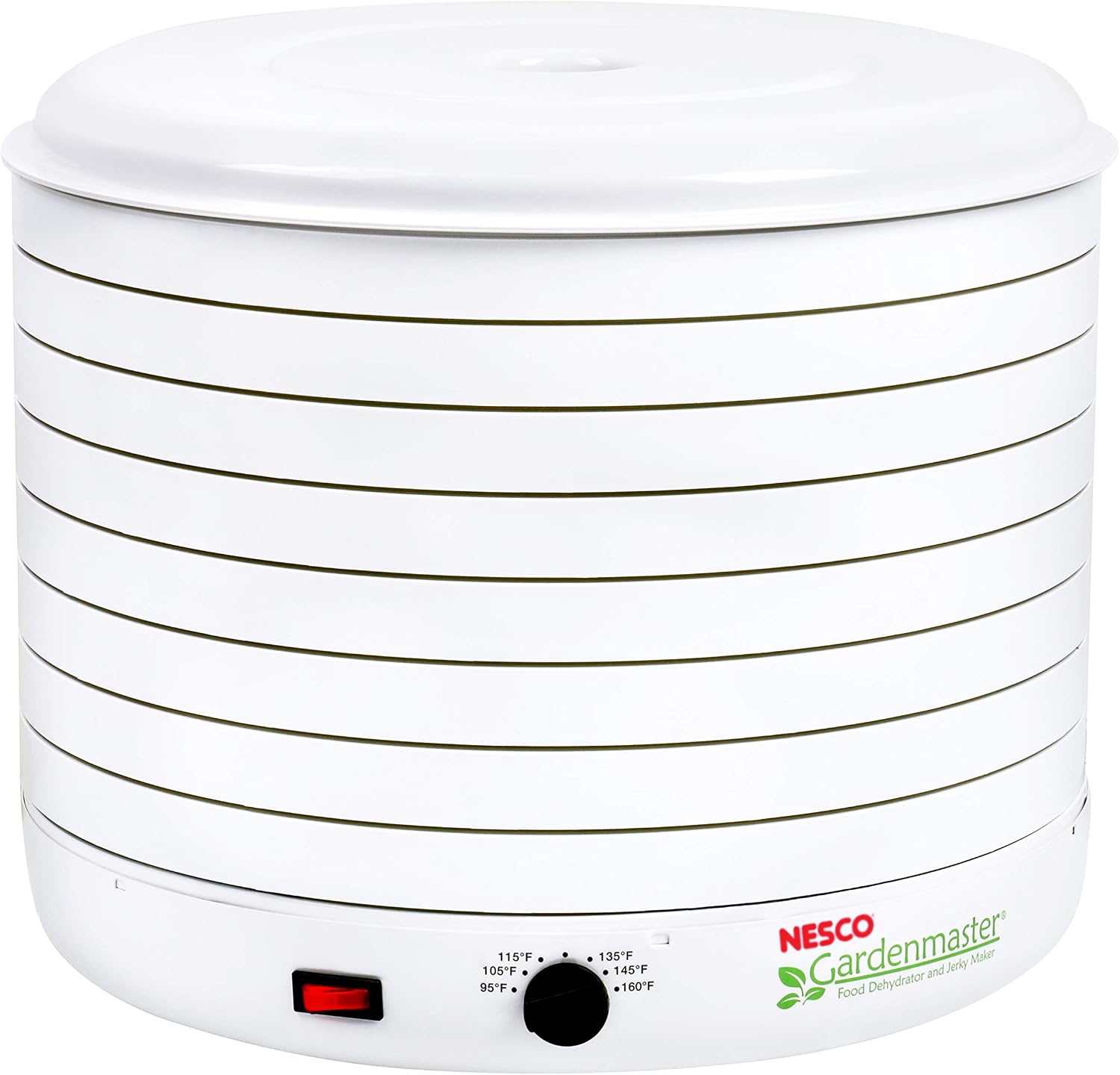
If you're drying enough food to actually stock a pantry through winter, the NESCO FD-1018A Gardenmaster is the one that won't leave you running two batches back to back. It ships with 8 square feet of drying space across its trays, but the real selling point is that it's expandable up to 30 trays if you ever need to scale up for a big harvest or a bulk jerky order.
The 1,000-watt motor is noticeably stronger than most of the other machines on this list, which matters more than people expect once you load the trays with anything wet, like tomatoes or zucchini. NESCO calls its airflow system Converga-Flow: air gets pushed up from the base and funneled inward toward the center of each tray instead of just blowing straight up. In practice, that means less tray-rotating and more even results, especially on the middle shelves where cheaper dehydrators tend to leave food underdone.
Temperature runs from 95°F to 160°F, which covers the low end for herbs and the higher end for jerky without needing a separate machine. The trays themselves are BPA-free plastic, dishwasher safe on the top rack, and the whole unit ships with fruit roll sheets, clean-a-screens for smaller items like herbs, a small sample of jerky seasoning, and a recipe booklet to get you started.
It's not the quietest machine in the room, and the round tray design does waste a bit of corner space compared to square trays, but if capacity is your main concern, this is the one to buy once instead of upgrading later.
COSORI CP267-FD Premium Stainless Steel Food Dehydrator Review

The COSORI CP267-FD is the model that consistently pulls in the best reviews from regular home users, and it's easy to see why once you've used one. Six stainless steel trays give you 6.5 square feet of drying space, and unlike the plastic trays on cheaper machines, there's no risk of BPA leaching or staining from acidic fruit.
Power sits at 600 watts with a rear-mounted fan pushing air horizontally across every tray, so nothing needs rotating halfway through a batch. Temperature runs from 95°F to 165°F in 5-degree increments, controlled through a digital touch panel with a timer that goes up to 48 hours, which is long enough to leave a big batch of jerky running overnight and most of the next day without checking on it.
What people mention most in reviews is how quiet it runs, under 48 decibels, so it's genuinely fine to leave going in the kitchen while you're working nearby or asleep in the next room. The glass front door is a small thing but a nice one; you can see how a batch is progressing without opening the door and losing heat.
It costs more than a basic stackable dehydrator, but the stainless steel build and even airflow are the reasons it holds up as a top pick year after year rather than getting swapped out for something cheaper.
Nesco FD-75A Snackmaster Pro Food Dehydrator Review
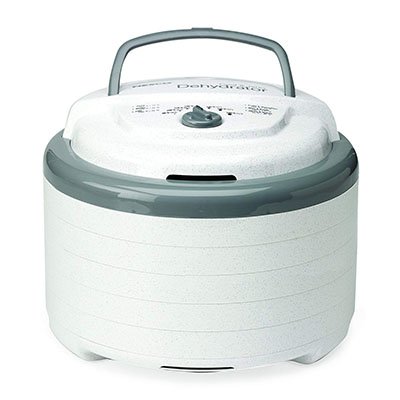
The Nesco Snackmaster Pro FD-75A is still the machine people recommend to first-timers, and after more than three decades on the market it's earned that reputation. It's a 600-watt model with an adjustable range from 95°F to 160°F, wide enough to cover everything from delicate herbs to a full batch of jerky.
Hot air is pushed out horizontally so you're not stuck rotating trays every hour to get even results. The round shape, swappable mesh sheets, and included jerky trays make it easy to switch between projects, and at 13 x 13 x 10 inches it sits on a countertop without taking over the kitchen.
It comes with a carry handle too, which sounds minor until you've tried moving a dehydrator full of trays to a porch or garage to keep the smell out of the kitchen. Just make sure you've got an outlet wherever you land it.
Presto 06301 Dehydro Digital Electric Food Dehydrator Review
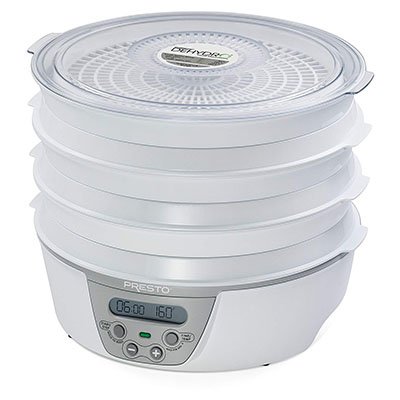
The Presto 06301 Dehydro stays on this list because it hits a genuinely good price for what you get: a 6-tray stackable design that measures 14.5 x 15 x 7.2 inches and weighs just 8.5 pounds, so it's easy to tuck away in a cabinet between uses.
The fan and heating element sit at the base, pushing air up through the stack, so trays don't need rotating during a normal run. The digital thermostat covers 90°F to 165°F, and the timer plus display make it simple to set a batch going before bed and forget about it.
It won't out-dry a horizontal-airflow machine on a packed load, but for someone drying a few trays of fruit or herbs at a time without wanting to spend three hundred dollars, it's still one of the better value picks around.
Excalibur 3926T 9-Tray Food Dehydrator Review

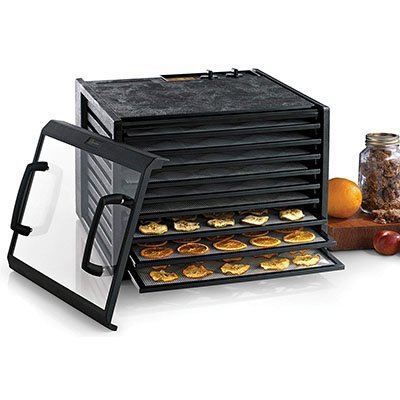
When people say they want "the good one," they usually mean the Excalibur 3926T. It's built in the USA, and it's the machine most serious home preservers and jerky makers eventually land on. Nine trays give you 15 square feet of drying space, more than almost anything else in this price range.
The heater and fan sit at the back of the unit, using Excalibur's patented Parallex Horizontal Airflow to push air evenly across every tray from behind rather than up through a stack. That's the reason it doesn't need tray rotation even on a full load of unevenly sized food, and why texture and color tend to come out more consistent than on vertical-flow machines.
The adjustable thermostat runs from 105°F to 165°F, and the 26-hour timer with auto shutoff means you can start a long jerky run and walk away without babysitting it. Beyond meat and produce, it's rated safe for raising bread dough, making fruit leather, and drying homemade pet treats, so it earns its keep beyond just preservation season.
It costs more up front than most of the machines here, and it takes up real counter or shelf space. But between the airflow design and the trays holding up to years of regular use, it's the one buyers tend to say they wish they'd bought first instead of last.
Hamilton Beach 32100A Digital Food Dehydrator Review
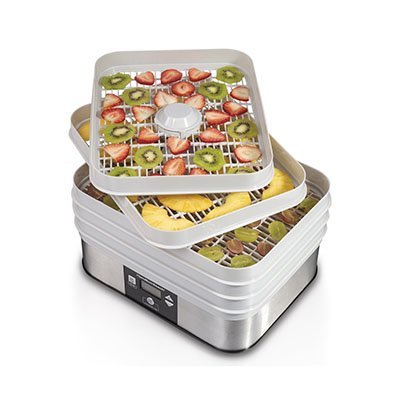
The Hamilton Beach 32100A is the rounded-rectangle option that's been quietly popular for years, and it's still one of the easiest machines here to just set and walk away from. It runs on 500 watts with the fan and heater base-mounted, giving 4.2 square feet of drying space across 5 stackable trays.
The digital thermostat covers 100°F to 160°F, and the 48-hour timer with auto shutoff means it'll stop on its own instead of running long after a batch is done. One fine-mesh tray is included for herbs and other small pieces that would otherwise fall through the standard trays.
The clear lids are a nice touch for checking progress without opening the unit and losing warm air. It's not the largest or the most powerful machine on this list, but for someone dehydrating in smaller batches on a budget, it does the job without any fuss.
Why You Need Food Dehydrator?
When you list all the appliances that you need installed in the kitchen, why should a good dehydrator be one of them? There are many reasons for owning one. First, it helps to lower the weight of your food to make it take up lesser space. Because most of the foods such as tomatoes, vegetables, and fruits are over 85% water, the machine helps to lower their weight for storage or even transport. Therefore, whether you want to pack enough food for the upcoming winter or control food associated costs by buying when supply is favorable and storing your supplies, a dehydrator is a must have equipment.
Drying is one of the best preservation methods that help food take longer without spoiling. By reducing the moisture content to about 20%, the environment becomes unfavorable for fungi, bacteria and molds to form on your food. Therefore, tomatoes that could not be stored for more than five days will be able to take even more than 90 days without getting damaged. Even for foods that are only available seasonally especially fruits, a dehydrator will make it possible for you to enjoy them the entire year. You can also easily prepare adequate food and store in jars for the entire winter session to avoid shortage.
A dehydrator at home is a sure way of cutting down on junk. Most vegetables bought at home go into waste because they spoil before they can be used. When you get a dehydrator, you will only use what is enough and preserve the rest. This is very important in helping to reduce the quantity of waste generated from your home. It also helps to cut costs associated with buying food daily and driving several kilometers every day to get supplies from the mall.
If you like using home grown herbs and spices, well, one of the things you need is a dehydrator. Herbs such as sage, thyme, basil, or oregano are easy to grow but also rot very easily. Simply dry them in a dehydrator and store in airtight jars to have assurance of using nutrient rich and chemical free spices. Remember that the machine also makes it possible to farm continuously because of ease of storage.
You will need a dehydrator to dry soaked seeds and nuts to keep them alive. When seeds are soaked, enzyme inhibitors are deactivated to commence the germination process. By drying the nuts and seeds after a short soaking period, you will be able to retain all the enzymes alive so that the lovely taste is not lost. Simply make sure that the drying process is done using mild temperatures to avoid killing the enzymes. You can therefore buy nuts in bulk, dry them in the dehydrator, and store them for making pecan pie on weekends or Christmas, use sunflower seeds on your lovely salad, or serve with cookies.
A dehydrator is a perfect machine to help in raising pizza dough faster. Once the pizza or bread dough has been prepared, it usually takes some time to rise. However, by placing the dough on the dehydrator, it will rise faster or you to prepare great pizzas. Therefore, if you only have some limited time, all you need is a dehydrator to make the dough rise promptly for the visitors or family to enjoy unforgettable delicacies.
Having a dehydrator in the house touches every part of your lifestyle. From helping to reduce waste and junk to cutting cost of food, it is one appliance that should never be omitted when buying home appliances. Remember to check out the different types and go for the model that is easy to maintain and delivers great results fast.
Conclusion
Dehydrators are special drying machines that give people greater control of the food they east, preservation timeframe and associated costs. Understanding how the machines operate is important selecting the right models, utilizing them appropriately, and maintaining them in top condition. The reviews outlined above helps to bring sharper focus into the features and their effectiveness in drying various types of foods. Think of the types of foods you would like to dry regularly, preserve for winter, or simply for fun and then narrow down on any of the best machines outlined above. With a dehydrator, your food will always be ready, tasty, nutritious and safe from germs.
Last Updated: 23rd Aug, 2026

Tumay Kilinc
Co-founder of Reviews By People. I'm here to make your buying decisions easier and save you time. If you have any questions, feel free to comment below.
Comments
Leave the first comment