Introduction
We all need to relax and enjoy some time off. Whether for a day hike, a quick weekend trip outdoors, or a week-long vacation and hiking is a great way to escape the hustle and bustle of everyday life for you and your family to relax and get away. Not to mention camping and hiking trips are cheap when compared to traveling and staying in hotels. So all you need is to have a great tent for your family.
Tips Before Buying a Family Tent
When purchasing a professional tent for camping and hiking, it is important to consider what type of hiking, backpacking/mountaineering, or camping you are going to be doing if you are going to be in cold weather for hiking or winter camping. You also want to consider that your camping and hiking gear will be used outdoors and needs to work once you get out there. Camping and hiking equipment, when being used, are constantly subjected to the elements, getting dropped, bumped, and packed, and everything else.
Buying cheap discount outdoor goods, gear, and hiking equipment made from low-quality discount materials will save you a few bucks upfront, but end up failing at the worst possible time and cost you more money, in the long run, having to replace. Spending a little bit more upfront on camping gear and hiking equipment will ensure that your outdoor sporting goods and backpacking/mountaineering supplies will perform when you need them most and will last, unlike their cheap discount counterparts.
This will ensure that your outdoor gear performs and save money in the long run over cheap discount hiking and camp supplies, not having to be replaced. If you are looking for a quality pavilion for your camping, bearing in mind that there are many different pavilions out there, the task of choosing the superior camping shelter for you can be a challenging one. There are many things that you need to put into consideration. Here is a look at some of these things that can guide you in the right direction and help you select the right one.
The family pavilion is large-sized that is made to accommodate a relatively large number of people, usually two adults and a child or up to 6 adults and or lesser adults with children. They are a necessity for outdoor camping, hiking, and road trips. There are many things to be considered when shopping for the top quality tents for you. These include pricing and budget, function, capacity, quality of materials, width and height of pavilion, portability, room size with consideration of privacy, and finally, ease of use. In this family tent review, I will try heart and soul to provide as much information so you can make the right decision for buying tents for camping.
Best Camping Tents For Family
It is the most important camping equipment which you need to consider when planning a camping trip. Having a superior tent will ensure not only your folks' comfort but also their safety.
It comes in all different shapes, types, and sizes with lots of various features. Finding a top-rated tent is a big hassle, and you might spend more or less intelligently.
Some time ago, I decided to buy one for our summer camping holiday. Being the kind of person who once has decided to buy something, I like to search for all the market quality ones. I spent so many hours on the internet, looking at camping stores, talking to people, looking through catalogs, and reading books searching for useful information about an excellent family tent. I have included the most important information, and I hope to be helpful if you are looking for a good pavilion and other camping gear.
In the following Coleman tent reviews, I want to emphasize some important attributes about the pavilion. Choosing the right camping shelter takes many factors that differ from person to person according to the size of your need, budget, preferences, special features, and other needs.
Every camping shelter have their strengths and weaknesses – so let's have a look at the first-rated camping shelters on the market at this time.
Coleman Elite WeatherMaster 6 Screened Tent Review

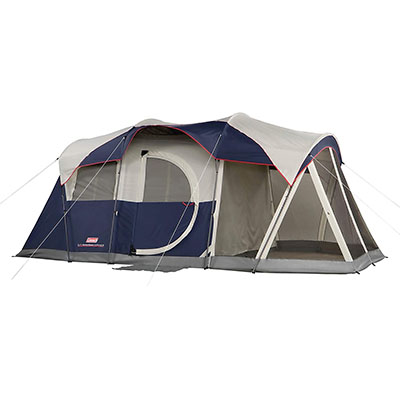
The Coleman Elite WeatherMaster Tent aims to be your home-away-from-home. True to Coleman's history of integrating innovative features into their reasonably priced tents, this cabin-style tent design comes with a load of thoughtful features, as well as three separate sizes that can sleep up to six, eight, or ten people.
Coleman begins thinking outside the box in the design of their D-shaped main door. Rather than the standard zippered enclosure, this door has hinges and functions like a real door. No more waking up everyone around you with a midnight run to the outhouse; this door design allows for a quiet entrance and exit. The tent fly protects the door from falling rain, allowing its mesh window to remain open for increased ventilation. A second zippered door aids in optimizing traffic flow in and out of the tent.
An LED light socket is integrated into the ceiling of the tent along with an illuminated wall switch. The light has three distinct settings, high, low, and nightlight, and it is powered by a battery pack holding four D batteries, which are not included. While this innovative touch might well replace a standard tent lantern, there is a gear hook sewn into the ceiling to accommodate a secondary source of light.
The Coleman Elite WeatherMaster tent comes with a further innovative feature by providing blinds for the spring-loaded windows and capable of rolling up on their own. This little bit of luxury keeps campers from the tedious task of manually rolling up multiple window covers and securing them. A zippered AC-power port is located on the back end of the tent should campers wish to run a power cord into the tent without letting critters in as well.
Coleman Elite Weathermaster Tent interior with an interior height of 80 inches, this tent can accommodate tall campers standing upright with ease. Its two rooms offer 153 square feet of space, with the dimensions measuring 17 x 9 feet. The tent is split into a screened porch perfect for setting up a protected sitting area and an indoor room for sleeping. While the screened porch has no floor, the tent's main body has a bathtub-style design to dissuade water from entering the tent. All seams are taped at the factory and waterproofed.
Where Coleman might suffer a near-fatal flaw in an otherwise perfect base-camp tent is, unfortunately, with its choice of materials. Though the tradeoff is great utility features and generous floor plans, the cost comes with Coleman's choice of fiberglass poles and low-end waterproofing and materials, doubtless chosen to help lower the overall price.
Overall, we gave the Coleman Elite WeatherMaster tent 3 out of 5 stars. Campers who demand durability from their tents and tend to experience extreme weather conditions repeatedly may want to consider a four-season base camp tent by a different manufacturer. For those who are car camping in reasonable conditions and want some cool perks like the LED light feature, this design might well reach tent Nirvana.
Coleman Montana 6 Tent Review

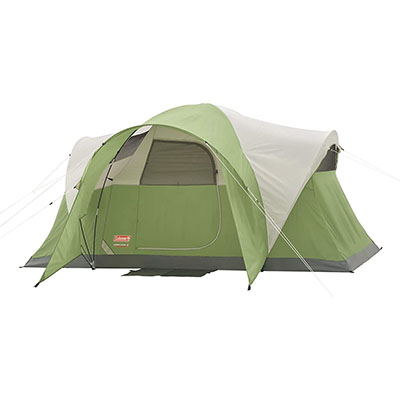
The Coleman Montana 6 Tent is ideal for light campground camping in reasonable weather conditions. Its roomy design allows for up to six occupants with gear. The tent footprint measures 12 x 7 feet, with 68 inches of interior height at the center of its semi-dome design. While the tent has only one room and no storage vestibule, it does offer occupants 84 square feet of living area.
Coleman chose to tackle interior tent condensation's common problem by adding mesh vents in the roof to increase airflow. Also, the two windows aid circulation inside the tent and can be zipped closed during inclement weather. There is one D-shaped door on the tent's broadside, utilizing Coleman's signature hinge design. No more surreptitious zipping needed for midnight runs to the outhouse; this door opens and shuts just like the one at home. Another innovative and welcome addition is the tent fly's awning, which serves to protect the door from stray raindrops when entering or leaving.
There is no gear loft in the Coleman Montana 6 tent, but a generous storage pocket keeps loose items organized. Besides, gear hooks on the ceiling allow for optimal lantern placement. A modern touch is the now-standard "Electrical Access Port." This zippered opening is located at the base of one wall and allows a power cord to run inside the tent while keeping small creatures outside where they belong.
Coleman Montana 6 Tent w/ Rain FlyThe Montana's rainfly is made of polyester taffeta with a 450mm coating to aid in dispelling moisture. However, the fly does not extend to the ground, which might present a problem should campers encounter sideways rain showers or high winds. All tent seams are factory-taped to prevent pooling water. Also, guy lines extend from the fly to ensure stability and are thoughtfully color-coded to keep campers from tripping over them unawares.
Like most Coleman tents, the setup is simple. The three tent poles feature pin-and-ring connection, while pole clips and continuous fabric sleeves offer added durability and ease during setup. The tent features the popular "bathtub" floor design to ensure against pooling water entering ground seams. Coleman offers no tent footprint to use in conjunction with this design, but campers can protect the tent's floor using conventional ground tarps during setup.
Overall we give the Coleman Montana 6 tent 4 out of 5 stars due to its ease of setup and relatively low price point. There are some drawbacks like the lack of an available footprint and a smallish rain fly, but this tent isn't designed or marketed for serious expeditions or harsh conditions, so we can't fault Coleman too much.
Coleman Instant 6 Person Tent Review

If you've ever been camping, you've probably heard of Coleman. From tents to stoves and everything in between, Coleman is one of the industry's most prominent names.
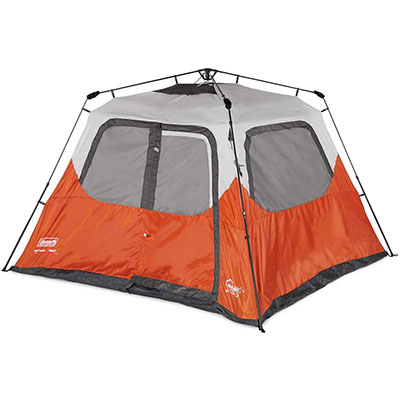
One of their latest offerings in the tent space is the Coleman Instant Tent 6. The Instant Tent is available in two models: the Instant Tent 6 and the Instant Tent 8—accommodating 6 or 8 people.
Coleman claims their latest tent can be set up or taken down in just one minute, hence the name Instant Tent. We were skeptical about the claim, so we decided to pick one up and test it for ourselves.
The first thing we noticed on getting the tent back to our shop was how heavy this thing is. We purchased the Instant Tent 6, and without packaging, it tipped the scales at a whopping 24.5 lbs. So you can probably rule this one out for anything other than car camping and backyard excursions.
However, once it's unpacked, the Coleman Instant Tent 6 does set up in under a minute. All the poles come pre-attached to the tent, so you essentially roll out the tent, raise the frame, and you're done. So yes, technically, the Instant Tent sets up in a minute. However, if you want to stake it down and set up the guy lines, it's more like five minutes.
Another claim that made us nervous was Coleman's boast that the Instant Tent's WeatherTec System was so waterproof, there was no need for a rain fly. WRONG! Saying that isn't farther from the truth. We surveyed a dozen current owners of the Instant Tent, and ALL of them had problems with leaks and condensation Coleman Instant Tent 6 Interior.
Coleman has received so many complaints about leaks they've decided to introduce a rain fly accessory in the spring of 2012.
Overall we give the Coleman Instant Tent 6 a two-star rating. It did set up in one minute, which is nice. But due to the weight, the additional set up a time for staking, etc. and the sieve-like weather resistance, we wouldn't recommend venturing too far from home with this model.
Making Your Tent More Comfortable
Camping is always fun. It gives you pleasure and the thrills you may need in your life. People often get bored and sick of their dull and mechanized life. That's why camping is done, right? But everything is a failure if you are not comfortable enough at your camping site. After a long journey, if you don't find comfort inside your tent, your outing will be wasted. It will be a waste of time. Find the right tent for you and your family, considering the size and everything else. Then you have to make your tent more comfortable on your own. How? This article will help you make your tent more comfortable. Follow the steps, and you are fine!
Firstly, find the right sized tent for your family or your group. Get a big tent if you have a big family or group. If you fail to find the right sized tent for your family or group, you will be suffering during your outing the whole time. Make sure your tent is big and spacious enough to accommodate all the people, and still, it has some space left to walk or roam around.
Find a surface that's not uneven. Most of the tents are not comfortable enough when you set them up on an uneven surface. So, find a space which is even so that you lay down comfortably inside your tent.
Try to find the perfect place to place your tent—a perfect place where you can enjoy enough air and a balanced temperature. Failing to find the right place can ruin your outing. For example, if you set your tent in a place where you can find no air, then you will be suffering. Find a place where the sunlight is not direct.
Bring mattresses with you. Put them inside your tent so that you can sleep in peace. Bring the cushions that you use at your home with you. You will be as comfortable as you were at home if you bring your mattresses and your cushions. Bring bed sheets and blankets with you. You will be cozy enough and feel at home if you bring these with you when you are outing.
You may get bored. So, bring your portable speakers, and you can listen to music inside or outside your tent. You can also bring books and magazines or newspapers with you if you love to read. You can read books when you are resting or going to sleep.
You can cook inside your tent. Many cookers nowadays can cook food using just the air around them, like the air fryers. If you have rooms inside your tent, you can make one of your kitchens and do the cooking inside it to not have to go outside for cooking.
If your tent is big enough, then you can place a table and some chairs so that you can eat or do some work on it. You will be more comfortable if you do this. But don't put a table or chairs inside your tent if it is small. It will be sophisticated inside your tent, and you will fail to find comfort.
You can put decorative lights inside your tent. They will make the interior of your tent look good. You will find it like home. Rather than that, it would help if you put lights so that it's bright inside your tent. Sufficient light is important at night. You can also hang up party lanterns if you have a mood of partying inside your tent.
You can take stand fans if you want more artificial air than the natural air that flows inside and outside. For that, you have to carry a battery for the power source. Or you can also carry a built-in battery-powered fan.
It would help if you took different types of clothes. It would help if you took swimsuits, sleeping clothes and other cozy clothes with you. Clothes are crucial during sleep. You must take your night suits which you wear at home.
People often don't find comfort at their camping. They get bored inside their tent. Following these steps will make your camping more comfortable.
Cleaning Up Your Tent
The last time you tried and failed cleaning up your tent, right? It got smaller, and it smells stinky, and it is has become non-waterproof. If you are a serious camper, then your tent is going to get dirty. Tents are more likely to pick up muds and dirt. During the rainy season or snowfall, tents get dirty, and it is tough when the tent is too dirty. But don't worry, this article is all about cleaning up tents in a clean way. You can clean up yours and make it look newer than ever. Just a few steps and you are done! Let's see how it goes.
In the beginning, you look for small objects which are outside or inside your tent. Small objects like needles, leaves, small cones, equipment, etc. are needed to be taken off from the tent. Then you can go to the washing. You cannot wash a tent which has objects inside it, right? Make sure you have emptied your tent before washing. Dirt is needed to be taken out too.
After cleaning off the dirt and the small objects, you can clean or wash it off with a piece of cloth or a soft brush. Don't rub too hard as you may harm your tent big time. It may lose its coating. Rub softly and make sure that all the dirt is gone away.
If your tent is small, then you can put it in the tub to wash it off. Don't put your tent in the washing machine, especially if it is made of nylon. If the tent is big, it will take your time to wash it off, and it will be a bit harder to wash a bigger tent than the smaller tents. When you are splashing water on your tent, make sure that every corner of it is getting wet.
Warning! Don't use any washing detergent. Use Nikwax tech. That's a popular non-detergent to wash off the tents. You can also go to any camping store and ask for non-detergents. Rub the soap or non-detergent softly but thoroughly. Just rub soap everywhere. Make sure it has soap everywhere. Otherwise, there will be dirt, and your tent will not be clean enough.
After that, you have to get rid of the soap you have used in your tent. You have to rinse it off with water. Don't just splash water on it. Rinse it thoroughly with water. Sometimes the soap is hard to be taken off. So, be careful about it. Make sure that soaps are gone. If the soaps are not gone, then your tent will be dirty as it was before. It will stink too.
Finally, after washing the soap off, you can leave it in your backyard or basement to dry. Make sure the sunlight and the heat of the sunlight are high. Otherwise, your tent will take too much time to dry off, and it will also stink if it is not perfectly dried off. So, always try to wash your tent when the heat of the sun is high. It will perfectly dry out the tent. Make sure you dry it thoroughly before taking it inside your house and storing it in your drawer. It will stink bad if it is not dried out thoroughly. It may take a while to dry off. Have patience!
You also can use water repellent to perfectly clean your tent. You can apply it on the fabric coated floor, the rainfly, and the lower sidewalls. Warning! Apply the water repellent on your tent while it's wet.
So, these are the steps that you can follow to completely wash out your tent and make it look like new again. These steps are easy and less time-consuming. If you have a big tent, it will cost you some time to wash out, but if you have a small tent, you can put it on your tub and wash thoroughly and leave no corner left while washing it out. But most importantly, dry out your tent perfectly so that it does not stink after you store it.
Last Updated: 21st Jan, 2025

Oğuz Tokatlı
Co-Founder, Editor, Content Creator, and Full Stack Web Developer of ReviewsByPeople.com. I am here to provide you the best content.
Comments
Leave the first comment